Orlando Trip Budget: Costs Beyond Theme Park Tickets
By StayNest Getaways · Research checked October 25, 2026
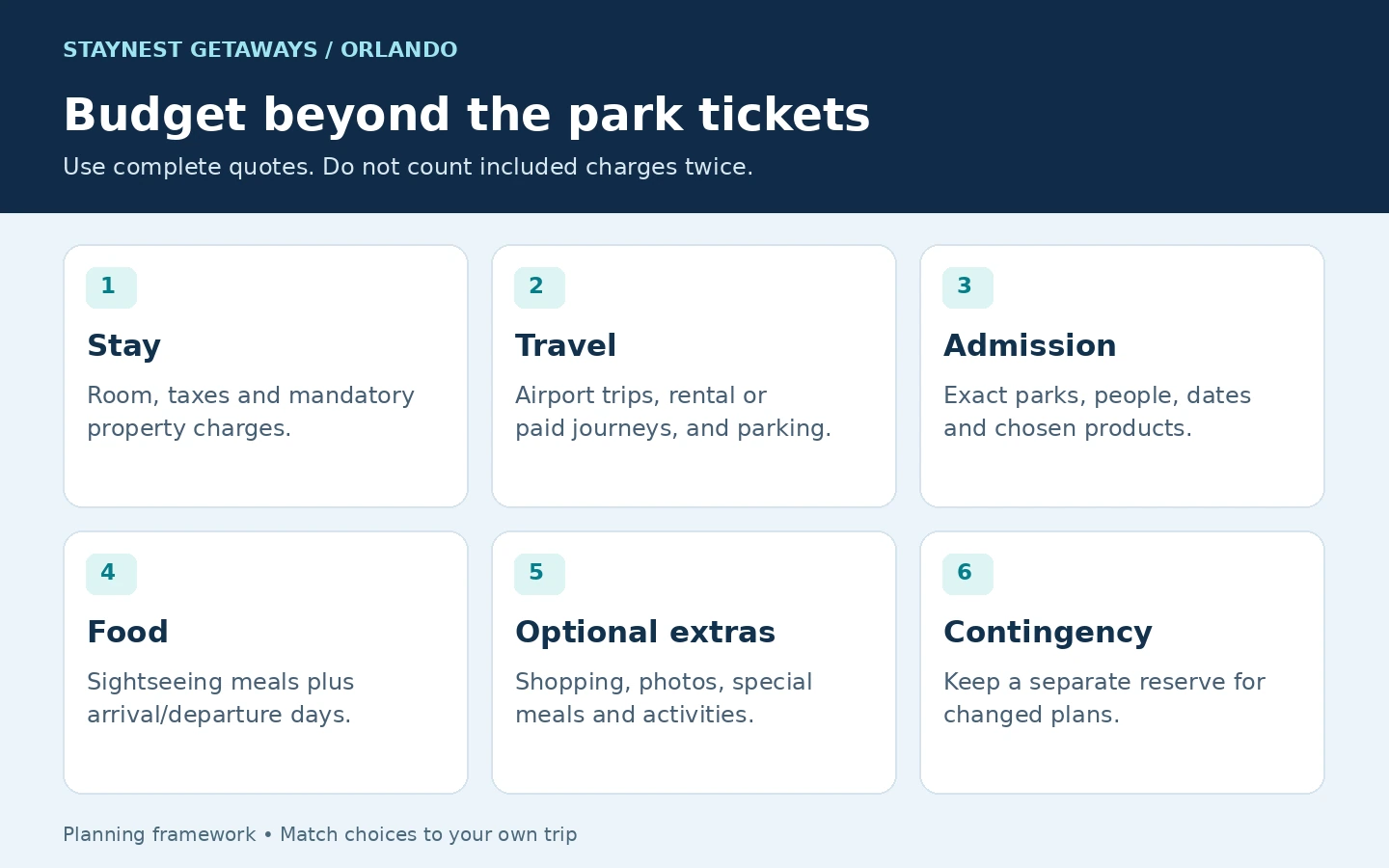
Build an Orlando budget in three layers: the cost of getting there, the cost of staying there and the cost of each day. Then separate the optional extras from the spending required to make your chosen itinerary work.
A low hotel rate and a ticket promotion are not a complete trip price. Parking, transportation, food and accommodation charges can change the comparison between two apparently similar plans.
This guide provides a budgeting method and an invented example. It does not quote live hotel rates, ticket prices, taxes, ride-share fares or typical household spending.
Start with the unit of comparison
Write down your travel dates, number of nights, full sightseeing days, ages or ticket categories, room requirements and destinations. Keep those assumptions identical when comparing options.
A five-night quote for two adults cannot be compared directly with six nights for a family. A ticket covering one park is not equivalent to one permitting the movements you have actually planned. Universal and Disney publish separate ticket conditions that should be checked before comparing offers. [1][2]
Record whether taxes and mandatory charges are already included. “Starting from” figures are useful for initial browsing but should not be the final numbers in your worksheet.
The complete budget checklist
| Budget category | What to record | Common mistake |
|---|---|---|
| Travel to Orlando | Airfare or driving costs, baggage and relevant transfers | Comparing a fare before adding baggage your party needs |
| Accommodation | Room total, taxes and mandatory property charges | Multiplying only the displayed nightly rate |
| Transportation | Airport transfers or rental, fuel/tolls where applicable, paid journeys | Counting only the outward trip |
| Parking | Hotel and destination charges that apply to you | Adding a fee twice or assuming an exemption |
| Admission | Exact parks, dates, people and product scope | Comparing unlike tickets |
| Food and drink | Meals by person and day, plus extras you intend to buy | Forgetting arrival/departure-day meals |
| Optional experiences | Dining upgrades, queue products, photos and events | Treating an optional purchase as included admission |
| Contingency | A separately identified reserve | Spending the reserve before departure |
Accommodation: ask for the full payable amount
Use the booking screen's final breakdown and the hotel's published conditions. Note what is paid now, what is paid later and what is only a refundable hold rather than an expected expense.
Include property-specific charges that apply to the reservation. For a vacation rental, inspect cleaning and any chosen extras rather than assuming a home's nightly rate works like a hotel quote.
Distinguish affordability from temporary cash flow. A refundable deposit may not be a final cost, but you still need to be able to fund it under the provider's terms.
Transportation: choose one primary scenario

Build a complete car scenario and a complete no-car scenario. Do not automatically add an airport transfer to a rental plan if the rental is collected at the airport, or omit the airport entirely because your hotel serves the parks.
For a rental, list the full rental total, applicable extras, fuel, toll arrangements and parking. For a no-car plan, list airport transfers and the actual number of paid journeys. Use quotes appropriate to your party and luggage.
Disney maintains current parking information and hotel-related conditions. [3] Check your eligibility before copying another traveler's fee into the worksheet. Universal hotel transport also depends on its published arrangements, so record which journeys are genuinely covered. [4]
Admission and queue products are separate decisions

Write each product's name beside its cost. Include valid dates, covered parks, ticket categories and any required activation or reservation steps from the supplier.
Disney's Lightning Lane information describes separate pass products and attraction availability. [5] Budget for a chosen product only after deciding what problem it solves. Do not imply that every admission ticket includes it, or that paying for it guarantees every ride with no wait.
Apply the same discipline to any Universal upgrade: establish what it covers at the parks on your itinerary rather than purchasing a vaguely defined “skip-the-line” extra.
Food: use a menu-led plan

Choose a realistic meal pattern: hotel breakfast if confirmed included, a simple lunch, a planned dinner, snacks and drinks. Look at the current menus of the places you might actually use.
For reserved meals, check payment, cancellation and what the quoted amount includes. Avoid assuming every traveler eats the same way or that every hotel breakfast covers the whole party.
Add meals on travel days where relevant. If you plan to prepare food in a rental, budget for groceries and the shopping journey. Only count cooking as a saving when you actually want to do it.
A fully hypothetical five-night family budget
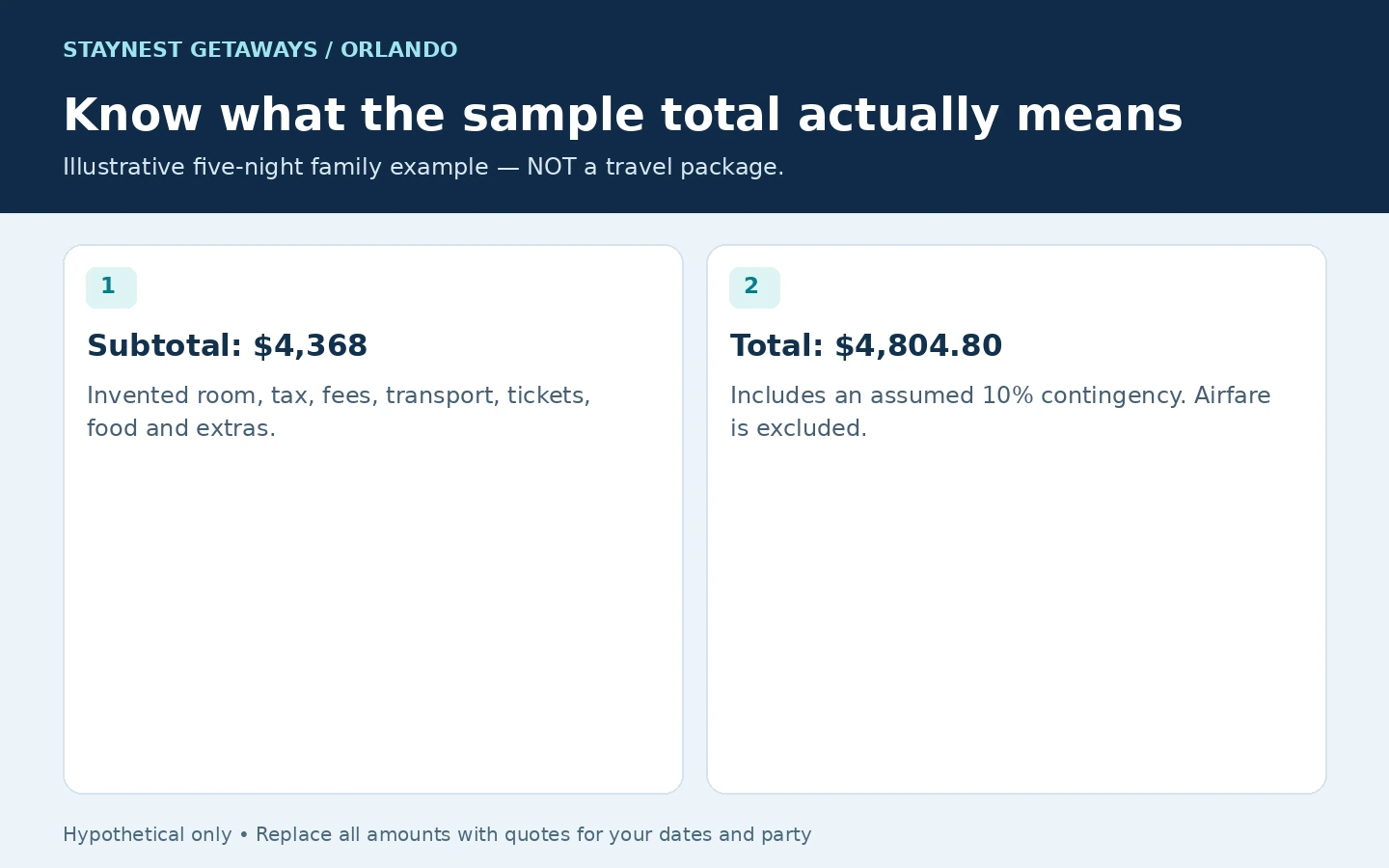
Assumptions: two adults and two children, five nights, five full sightseeing days, three chosen park days. Arrival is before those five days and departure after them. The figures are invented planning inputs, not researched Orlando averages. Airfare is excluded because no origin or dates have been specified.
| Invented input | Calculation | Amount |
|---|---|---|
| Room subtotal | 5 × $180 | $900 |
| Assumed accommodation tax | 12% × $900 | $108 |
| Assumed mandatory stay fees | 5 × $20 | $100 |
| Airport transfers | Assumed total | $120 |
| Other paid transportation | Assumed total | $240 |
| Three park days for four travelers | Assumed $1,800 total; not a ticket quote | $1,800 |
| Five sightseeing days of food | 5 × assumed $160 for the party | $800 |
| Food on arrival/departure days | Assumed combined amount | $120 |
| Optional shopping/photos/activities | Chosen allowance | $180 |
| Subtotal before contingency | $4,368 | |
| Contingency assumption | 10% of subtotal | $436.80 |
| Illustrative total, excluding airfare | $4,804.80 |
The 12% tax is an illustration applied only to the room subtotal; it is not a statement of the rate or taxable base for a real property. The ticket line is a placeholder assumption for arithmetic, not a claim that your party can purchase that itinerary for $1,800.
Replace each line with a real quote before making a spending decision. If a fee is already in the quote, do not add it again. Decide separately whether you need insurance or other products, and use your actual provider's terms and price.
Reduce spending without undermining the trip
Compare fewer park days with a fuller experience at those parks, rather than buying more days to satisfy a checklist. Review the accommodation location before cutting a useful transport allowance. Avoid non-refundable commitments until your essential itinerary is stable.
Set a souvenir allowance in advance. If your group values one special meal more than several small purchases, allocate accordingly. The aim is to protect your priorities, not remove every enjoyable extra.
Keep a separate list of refundable holds and payment deadlines so the cash available during the trip matches the budget on paper.
Frequently asked questions
How much does an Orlando trip really cost?
It depends on origin, dates, party size, accommodation and admission choices. The example here explains the method; it is not a market estimate. Obtain matching quotes for your own trip.
Are theme-park tickets the biggest cost?
They may be, but airfare and accommodation can change the picture. Calculate the full trip before deciding which category deserves the most attention.
Should I book the lowest total immediately?
Compare product scope and cancellation terms first. A cheaper non-refundable option may be less suitable if dates remain uncertain.
Your next step
Collect a final accommodation breakdown, the exact admission products and one complete transport plan. Those three items turn a rough wish list into a usable budget.
Sources
[1] Universal Orlando ticket information.
[2] Disney trip-management information.